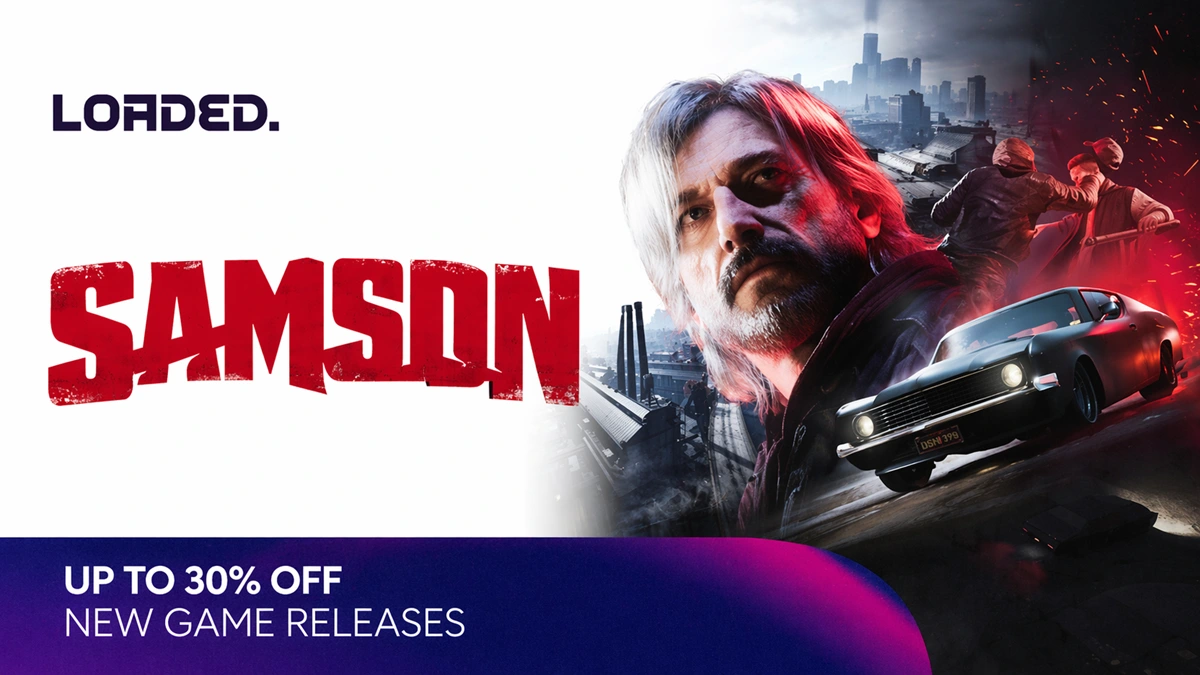
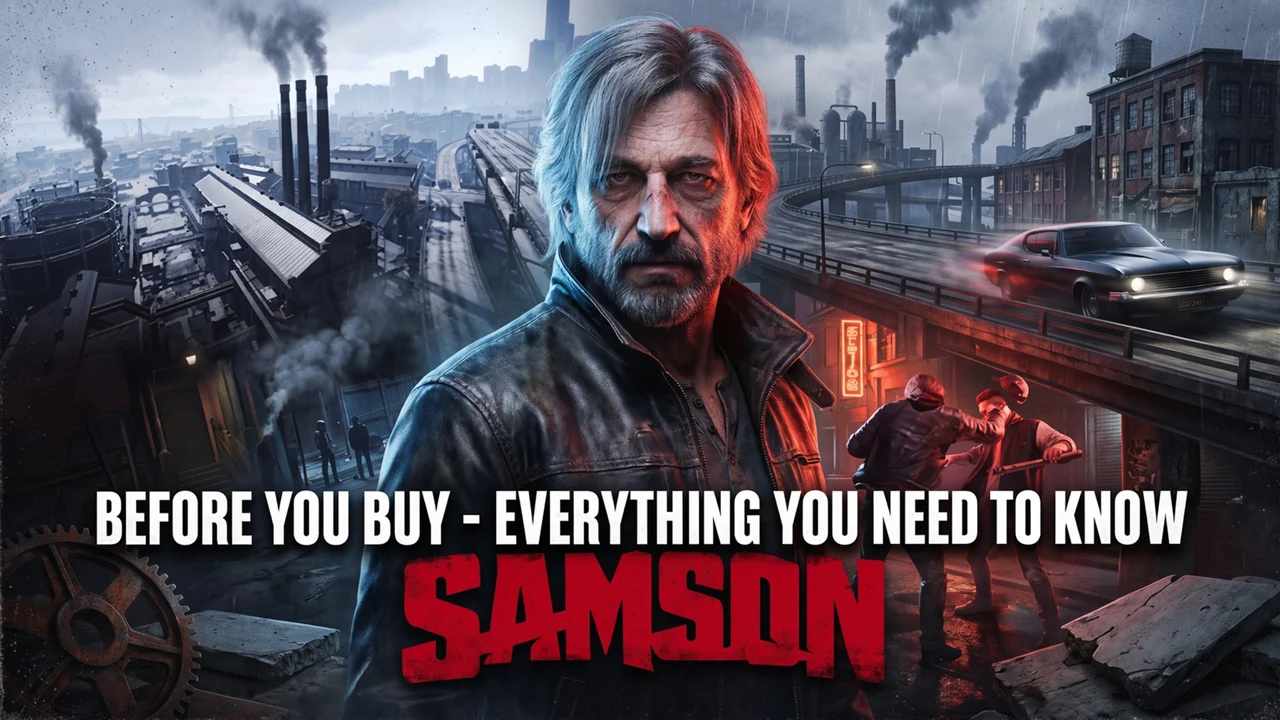
Samson: Before You Buy
Everything You Need to Know
Samson: A Tyndalston Story has one of the most compelling pitches of any game released in 2026. A gritty, focused open-world brawler set in a decaying 90s-inspired city, built by the creator of Just Cause, where every in-game day ticks down toward a debt deadline and your sister’s life hangs in the balance. No bloat, no filler, just raw street-level survival.
The problem is that the game launched in a state that doesn’t live up to that pitch. Not yet, anyway.
This guide breaks down what Samson gets right, where it falls apart, the current state of patches, and whether you should buy it now, wait, or skip it entirely.
What Is Samson?
Samson: A Tyndalston Story is an open-world action-adventure game developed and published by Liquid Swords, a Stockholm-based studio founded by Christofer Sundberg, the co-creator of Just Cause and former founder of Avalanche Studios. The studio also includes veterans who worked on Mad Max.
You play as Samson McCray, a former getaway driver who returns to his crime-ridden hometown of Tyndalston after a job in St. Louis goes sideways, leaving him with a massive debt. His sister, Oonagh, has been taken hostage by the gang he owes, and the only way to get her back is to pay off the debt before time runs out. Every day, the bill grows, and the pressure never lets up.
The game launched on April 8, 2026, exclusively on PC via Steam and Epic Games Store. Console versions have been mentioned but no dates have been announced. Liquid Swords has positioned the game as a focused, no-filler alternative to bloated open-world games, with a compact map, a tight 10-20 hour runtime, and zero microtransactions.
What Samson Gets Right
A Genuinely Innovative Structure
The standout feature of Samson is its debt-driven time management system. You owe roughly $100,000, and each day you’re required to make a payment of a few thousand dollars. If you fall short, the consequences carry forward — there are no do-overs or save reloads to bail you out.
Each in-game day gives you a limited pool of Action Points. Every job, mission, or activity costs AP, so you can’t just grind endlessly. You have to be strategic about which opportunities to pursue and which to skip. Take on a high-risk job for a bigger payout, or play it safe with smaller gigs? Every choice matters because you’re always racing the clock.
This creates a genuine sense of desperation that most crime games only talk about but never actually make you feel. One reviewer described losing an entire day’s earnings by getting jumped on their last mission — a devastating, unscripted moment that perfectly captures what the game is going for.
Tyndalston Has Real Atmosphere
The fictional city of Tyndalston is the game’s quiet star. Inspired by 1990s Northeastern American cities like New York and Philadelphia, it’s a dense, compact urban environment dripping with gritty atmosphere. The art direction uses a dark, earth-toned palette that nails the 90s crime aesthetic. Rather than sprawling across a massive map, Tyndalston is built around distinct hostile neighborhoods, hidden corners, and layered vertical spaces designed for brawling, chasing, and escaping.
The city also reacts to your actions. Factions, NPCs, and street-level dynamics shift based on what you do, giving Tyndalston a social memory that tracks whether you’re rising or falling. The voice acting and soundtrack reinforce the noir tone throughout, even when other elements of the game struggle to keep up.
Satisfying Core Combat (When It Works)
Samson’s brawling system emphasizes heavy, physical melee combat — think Sleeping Dogs meets early 2000s crime games. You have light and heavy attacks, parries, evades, shoves, and the ability to throw objects and use the environment. When everything clicks, fights feel brutal and grounded. Landing a well-timed counter or slamming an enemy into a wall carries real weight.
The game also features vehicular combat where cars act as battering rams. Chases involve ramming, drifting, sideswiping, and using nitro boosts. The “kick down” gear-shifting mechanic adds a satisfying layer of control to driving. A skill tree with 25+ upgrades across four categories — Instinct, Tactics, Aggression, and Cunning — lets you shape Samson’s fighting style over the course of the game.
Refreshing Budget and Scope
In an era of $70 games padded to 100+ hours, Samson deliberately goes the other direction. It’s a focused, 10-20 hour experience that doesn’t pretend to be something it’s not. There are no microtransactions, no season passes, and no live-service hooks. The Supporter Edition adds a digital soundtrack, concept art, and a lore map for a small premium, but nothing gameplay-related.
Where Samson Falls Apart
The Technical State Is Severe
This is the elephant in the room. Samson launched with serious, pervasive technical issues that undermine nearly every aspect of the experience. Multiple reviewers and players have reported frame rate drops well below 60 FPS even on high-end hardware, mission-breaking bugs that force desktop restarts, poor NPC AI that freezes or behaves erratically, clunky character movement with frequent environment collision issues, and performance that degrades the longer you play in a single session.
One reviewer running a 3080 and Ryzen 5700X3D couldn’t maintain stable 1080p performance on medium settings with DLSS set to Performance. Multiple comparisons have been drawn to the launch states of Cyberpunk 2077, Starfield, and even No Man’s Sky in terms of how far the game is from where it needs to be. This isn’t a case of minor launch jank — core systems are genuinely broken for many players.
Combat and Driving Need Work
While the foundations of combat are solid, the execution has problems. Hit detection is inconsistent, animations feel stiff and repetitive after the first few hours, the camera frequently misbehaves during fights, and encounters with more than three enemies become frustrating. Enemy AI is unreliable, sometimes freezing mid-fight or behaving unpredictably.
Driving fares slightly better but still has issues. Cars feel heavy by design, which some players enjoy, but others find sluggish and unresponsive. During chase missions, target vehicles sometimes get stuck on nothing, break their AI pathing, or clip into the environment. You also can’t carjack occupied vehicles — you have to find empty parked cars, and in some areas there simply aren’t any, leaving you stranded on foot.
No Manual Saves
Samson uses a strict autosave system with no option to manually save. This is an intentional design choice meant to reinforce the consequences-matter philosophy, but combined with the game’s bugs, it creates real frustration. If a mission breaks or you lose progress due to a glitch rather than a gameplay decision, there’s no way to recover. This is one of the most criticized aspects of the current build.
Repetitive Mission Structure
The core gameplay loop of taking on jobs to earn money becomes repetitive faster than it should. Side missions lack narrative context, and the variety of available activities is limited. Several critics noted that by the midpoint, you’re essentially doing the same types of brawling and driving jobs on repeat, and the story doesn’t develop enough depth outside the main missions to sustain the grind.
A Studio Under Pressure
Liquid Swords went through significant layoffs during development, and the game was reportedly scaled down late in production. The impact is visible in the final product — systems that feel half-implemented, a world that has the bones of something larger, and a general lack of polish across the board. This context doesn’t excuse the launch state, but it explains why a team with this much talent shipped a game that clearly needed more time.
Performance and System Requirements
Samson is built on Unreal Engine 5 with Nanite, Lumen, ray tracing, and DLSS support. Despite these high-end features, the game is designed for mid-range hardware on paper — though real-world performance has been inconsistent since launch.
PC Minimum Requirements
- OS: Windows 10/11 64-bit
- CPU: Intel Core i5-10505 / AMD Ryzen 5 3600
- GPU: NVIDIA GTX 1070 (6GB) / AMD RX 5600 (6GB)
- RAM: 16 GB
- Storage: 15 GB SSD (required)
PC Recommended
- CPU: Intel Core i5-11400 / AMD Ryzen 5 5600 XT
- GPU: NVIDIA RTX 3060 Ti (8GB) / AMD RX 6700 XT (8GB)
- RAM: 16 GB
- Storage: 15 GB SSD (required)
Key Notes
- An SSD is mandatory, not just recommended
- DLSS 4.5 is supported for NVIDIA users
- DirectX 12 is required
- Despite modest official requirements, actual performance is unstable — many players report significant frame drops and stuttering even on hardware well above recommended specs
- The developer has acknowledged optimization issues and included performance fixes in their first patch
- PC only at launch — PlayStation and Xbox versions are planned but have no release date
Review Scores at a Glance
Samson launched to a Metacritic score of approximately 48-54 (varying across aggregator snapshots) and an OpenCritic score of 55, rated “Weak” and ranked in the bottom 10% of reviewed games. Steam user reviews currently sit at Mixed (57% positive from 1,249 reviews).
The critical consensus is clear: the concept is strong and the atmosphere is excellent, but the technical execution, buggy combat, and lack of polish prevent the game from delivering on its promise. The most positive reviews (scoring 70-80) tend to come from critics who see through the bugs to the game’s potential and find the budget positioning generous. The most negative reviews (scoring 20-40) describe a game that shouldn’t have shipped in its current state.
Post-Launch Support and Roadmap
Liquid Swords has been responsive since launch. They released an April 2026 roadmap outlining multiple patches, with the first update already live. Early fixes include progression-blocker fixes for broken missions, controller input speed adjustments, reduced Action Point costs for Street Trials to improve balance, vehicle gameplay improvements including faster engine starts and undercarriage damage removal, and general stability and performance improvements.
A larger patch was scheduled for mid-April with broader stability fixes, game feel adjustments, and additional polish. The developer has communicated openly with the community through Steam updates and acknowledged the scope of the issues. Whether they can turn the game around remains to be seen, but the willingness to engage is encouraging.
Who Should Buy Samson Right Now
Consider buying if you:
- Love gritty, 90s-inspired crime games and miss the era of True Crime, early GTA, and Driver
- Appreciate innovative systems like the debt/AP time management even in rough packages
- Are highly tolerant of bugs and early-access-level polish in exchange for a unique experience
- Want to support a small indie studio at a budget entry point
- Have patience to wait for patches while playing through the rougher parts
Wait for patches if you:
- Want the experience the game is clearly trying to deliver, but need it to actually work reliably first
- Get frustrated by mission-breaking bugs, unstable performance, and no manual save option
- Prefer to buy games when they’re in a more finished state
- Want to see how the mid-April and future patches address core issues before committing
Skip entirely if you:
- Expect polished, AAA-quality execution at any budget level
- Need an engaging narrative with well-developed characters beyond the initial premise
- Dislike games where repetition sets in quickly
- Are looking for a large, content-rich open world
The Verdict
Samson: A Tyndalston Story is one of the most frustrating releases of 2026 because you can see exactly what it’s trying to be, and that game sounds fantastic. A focused, consequence-driven crime brawler with a ticking clock, a compact world dripping with atmosphere, and the experience of Just Cause and Mad Max veterans behind it. On paper, this is everything a certain kind of player has been craving.
In practice, the game shipped before it was ready. The bugs are pervasive, the performance is unstable, the combat and driving need significant tuning, and the lack of manual saves turns technical issues into gameplay-destroying problems. At its best moments, Samson delivers flashes of the gritty, physical, street-level action game it wants to be. At its worst, it feels like an early access title that needs months of additional development.
The budget entry point works in its favor, and Liquid Swords is actively patching. If the concept speaks to you, wishlisting it and checking back after a few major patches is the smartest move. For the patient and the bug-tolerant, there’s a diamond in the rough here. For everyone else, Tyndalston isn’t ready for visitors yet.
Frequently Asked Questions
Is Samson multiplayer?
No. Samson is a single-player game with no co-op or online multiplayer.
How long is Samson?
The main story takes approximately 8-10 hours. Full completion with all side content runs around 15-20 hours depending on playstyle and how efficiently you manage your Action Points.
What platforms is Samson available on?
PC only (Steam and Epic Games Store) at launch. Console versions for PlayStation and Xbox have been mentioned but have no confirmed release dates.
Can I save manually?
No. Samson uses a strict autosave system with no manual save option. Your choices and failures are permanent, which is intentional but frustrating when combined with the game’s current bugs.
Is Samson like GTA?
Samson draws comparisons to early GTA, True Crime, Driver, and Sleeping Dogs, but it’s a much smaller, more focused experience. It’s a compact AA brawler with driving, not a massive open-world sandbox. There are no guns — combat is entirely melee and vehicular.
Does Samson have microtransactions?
No. There are no microtransactions, season passes, or live-service elements. The Supporter Edition adds a digital soundtrack, concept art, and a lore map, but nothing that affects gameplay.
Who made Samson?
Liquid Swords, a Stockholm-based studio founded by Christofer Sundberg, co-creator of the Just Cause series and former founder of Avalanche Studios. The team includes veterans who worked on Mad Max.
Is the game getting patched?
Yes. Liquid Swords has released an April roadmap with multiple patches planned. The first update is already live with bug fixes, balance adjustments, and performance improvements. A larger patch targeting broader stability and game feel was scheduled for mid-April 2026.
Does the debt actually increase if I don’t pay?
Yes. The debt grows with interest, and missing your daily payment quota makes subsequent days harder. The system is designed to create escalating pressure throughout the game.
Samson: A Tyndalston Story contains mature content including violence, strong language, and drug references. No official ESRB rating has been assigned.
This article contains affiliate links. Gaming Garden may earn a commission on purchases made through these links at no additional cost to you.